
EASTERN FAIRY TALE-UZBEKISTAN



“Step off the Silk Road and into a living fairy tale — turquoise domes, mountain gondolas, sizzling plov, and cities older than Rome, all in one unforgettable week through the heart of Central Asia.
Included/Excluded
- Airport & train station transfers
- Hotel accommodations in standard double rooms with breakfast
- Economy class train tickets on the Afrosiab train for the following routes: Tashkent-Samarkand, Samarkand-Bukhara, and Bukhara-Tashkent
- Guided excursions according to the tour itinerary
- Entrance fees to city monuments
- Lunch at the Besh Kozon Central Asian Plov Center, lunch at the Charvak Reservoir
- Cable car tickets at the Amirsoy mountain resort
- Comfortable air-conditioned transportation throughout the tour
- Mineral water (1 liter) for each excursion day of the tour
- International airfare
- Meals, except as specified in the tour itinerary
- Medical expenses and insurance
Tour Plan
Breakfast at the hotel.
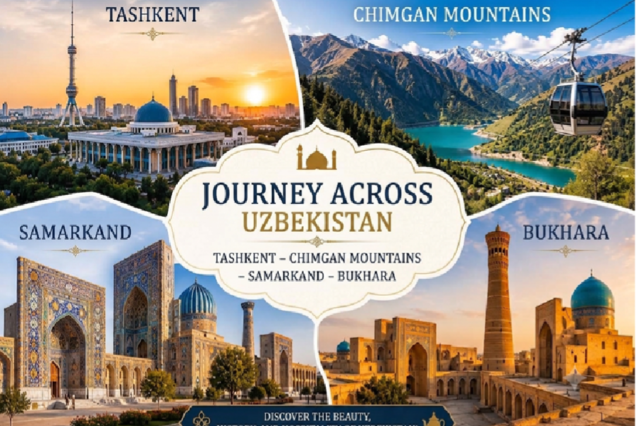
At 10:00 AM, transfer to the Chimgan Mountains – a picturesque resort area in the spurs of the Western Tien Shan, located just 85 km from Tashkent. The mountain range stretches from 1,600 to 3,309 meters above sea level. Its highest point is the majestic Greater Chimgan (3,309 m), visible even from the capital on a clear day.
Explore the modern Amirsoy mountain resort. Ascend to the observation deck at 2,290 meters on a comfortable gondola lift. From the top, breathtaking views of the Chatkal Range, the azure waters of the Charvak Reservoir, and the picturesque village of Brichmulla open up. A walk along mountain trails, where freshness, silence, and a special atmosphere, filling with energy and inner harmony, reign year-round.
Return to Tashkent. En route, a lunch stop at the Charvak Reservoir, home to cozy cafes and restaurants serving national cuisine and Uzbek shashlik, famous throughout the region.
Overnight at the hotel.
Meals: breakfast, lunch
Send feedback.
Breakfast at the hotel.
The tour of Tashkent’s Old City includes a visit to Khast-Imam Square, the spiritual heart of the capital, home to the Barak Khan Madrasah and the Kafal-al-Shashi Mazar mausoleum, some of the city’s oldest architectural monuments. The program also includes a visit to one of Tashkent’s most colorful and ancient markets, the Chorsu Bazaar. Its majestic dome offers a wide selection of local produce, spices, handicrafts, and souvenirs. In the Old City, in addition to traditional Eastern architecture, you can see authentic mahallas with adobe houses, narrow streets, and the unique atmosphere of historic Tashkent.
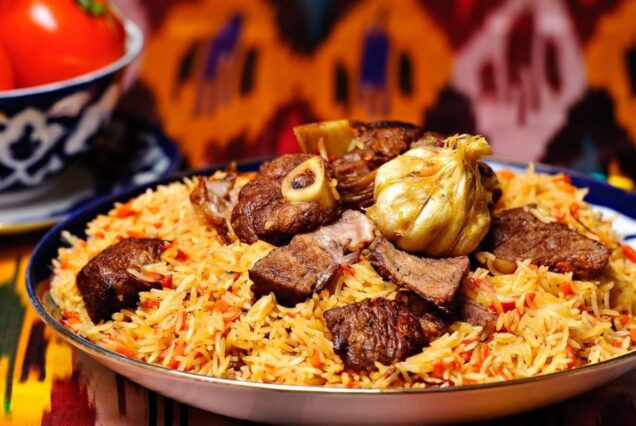
Lunch at the Besh Kozon Central Asian Plov Center, where up to 10 tons of aromatic, traditional plov are prepared daily in huge cauldrons. Transfer to Samarkand by train (7:48 PM – 10:13 PM*, travel time: 2 hours 25 minutes).
Samarkand has long been called the “pearl of Islamic architecture” and the “mirror of the world.” A contemporary of Rome, Athens, and Babylon, this great city boasts a 2,750-year history. Samarkand reached its peak during the reign of Amir Temur, an outstanding military leader and ruler of Central Asia after Genghis Khan, when the city became the capital of the powerful Empire of Transoxiana.
Overnight at the hotel.
Meals: breakfast, lunch
Breakfast at the hotel.
Samarkand tour: Central Asia’s most famous square, Registan, surrounded by three monumental madrassas – Sher-Dor, Tillya-Kari, and Ulugh Beg; the Gur-Emir Mausoleum, the grandiose dynastic tomb of Tamerlane, which served as the prototype for the Humayun Mausoleum in Delhi and the Taj Mahal in Agra; Central Asia’s largest cathedral mosque, Bibi-Khanum, imbued with regal beauty; Samarkand’s largest market, Siab Bazaar; the architectural ensemble of 11 medieval mausoleums, Shahi-Zinda; and the Ulugh Beg Observatory Museum, one of the most significant observatories of the Middle Ages, where a fragment of a giant sextant remains buried.
Overnight at the hotel.
Meals: breakfast
Breakfast at the hotel.
Transfer to Bukhara by morning train (09:53-11:49*, travel time: 1 hour 46 minutes).
Since ancient times, Bukhara has been the heart of a bustling oasis. The city’s history spans over 2,500 years. Having managed to preserve its unique charm and boasting over 140 ancient architectural monuments, Bukhara remains one of the most attractive cities for travelers. The historic center of Bukhara is included in the UNESCO World Heritage List.
Excursion to surrounding areas: the summer residence of the last Bukhara Emir, the Sitorai-Mohi Khosa Palace; the “Central Asian Mecca” – the memorial complex of the famous philosopher and Sufi of the East, Bakhautdin Naqshbandi. Bukhara tour: Lyabi-Khauz Ensemble – Bukhara’s most famous square with an artificial pond, surrounded by the Kukeldash Madrasah, the Nadir Divanbegi Madrasah, a khanaka, the famous monument to Khoja Nasreddin, and numerous cozy cafes. Visit the 16th-century covered bazaars, where folk craft workshops are on display.
Visit a museum-workshop with a small puppet theater in Lyabi-Khauz Square. Visitors to the museum not only relive their childhood but also expand their knowledge of national puppet art.
Overnight at the hotel.
Meals: Breakfast
Breakfast at the hotel.
Continuation of the Bukhara excursion: the Samanid Mausoleum – a dynastic tomb combining the traditions of Sogdian and Islamic architecture; an unusual mausoleum in the shape of an oblong prism, associated with the biblical legend of the wandering Job – Chashma Ayub; the Bolo-Hauz complex – a monumental part of Bukhara’s monumental Registan, consisting of a pond, a minaret, and a mosque decorated with 20 carved wooden columns; the citadel of ancient Bukhara, a “city within a city” – the ancient Ark Fortress; the oldest building in the ceremonial square, the central ensemble and main symbol of Bukhara – the Poi-Kalyan complex, including the famous Kalyan Minaret (46.5 m), the Kalyan Mosque, and the Miri Arab Madrasah; the Abdulaziz Khan Madrasah; Ulugh Beg Madrasah.
Transfer to Tashkent by evening train (4:22 PM–8:30 PM*, travel time: 4 hours 8 minutes).
Overnight at the hotel.
Meals: breakfast
Breakfast at the hotel.
Group transfer to Tashkent airport 3 hours before flight departure.
Tour ends.
Meals: breakfast
You May Like
UZBERKISTAN CLASSIC TOUR
Cuba. Relax Tour. 13 days